Freehold vs Leasehold in Penang: Which Is the Right Choice?
Pros and cons of freehold vs leasehold in Penang — resale value, bank financing, lease renewal realities, and which areas are dominated by each type.
Alpian Ali
Perunding Hartanah Berdaftar · Updated 24/04/2026
An Important Decision: Freehold vs Leasehold in Penang
The freehold vs leasehold debate is one of the most consistently discussed topics in the Penang property market — and for good reason. Freehold tenure offers unmatched security for long-term wealth preservation and inheritance, while leasehold can be strategically superior for investors targeting optimal rental returns in the early years.
In reality, comparing luxury units in premium locations like Tanjung Tokong and Pulau Tikus goes far beyond physical price alone. The right decision is closely tied to the remaining lease formula and increasingly stringent bank financing conditions heading into 2026.
Here are the five key determining factors to examine before taking your next step.
Factor 1: Ownership Duration
The optimal tenure choice depends entirely on your personal intended holding period. Freehold is clearly superior for long-term asset preservation, while leasehold units can generate faster cash returns if sold or rented according to a well-timed schedule.
This difference in planning horizon has a significant impact on your eventual capital gain margin.
A strategic guide based on target holding period:
- Under 10 Years: Leasehold performs very well here. Lower entry costs generate higher rental yields, and the remaining lease is still comfortable enough for buyers to secure bank financing without difficulty.
- 10 to 20 Years: This transitional phase requires careful calculation, as the leasehold value curve often begins to plateau. You need to assess whether the premium paid for a freehold unit upfront is worth more than the potential resale trajectory.
- Beyond 20 Years (Inheritance Asset): Freehold consistently records impressive capital appreciation — averaging 6%–7% per year based on recent data. It also spares future generations the administrative burden and significant renewal premium costs.
Factor 2: Lease Renewal Realities
Extending a leasehold title requires a substantial cash payment calculated using the state government’s assessment formula — and approval is not guaranteed. Applications must be submitted well in advance, along with the applicable premium, before the remaining tenure approaches the critical 60-year mark.
Property owners are strongly advised not to delay this process. JPPH (Department of Valuation and Property Services) will calculate the premium based on the current market valuation of the property at the time of application.
Every year of delay means the renewal premium escalates alongside rising land prices across northern Malaysia heading into 2026.
The administrative procedure at state government level involves the following steps:
- Application form and original ownership documents filed at the Penang Land and Mines Office
- Official site visit and valuation report issued by a state JPPH officer
- Premium amount confirmed based on current market value ratio — the standard extension period is typically 99 years
- Waiting period for formal approval and new title issuance: 6–12 working months
For the large-scale reclamation projects at Seri Tanjung Pinang (STP), the developer Eastern & Oriental (E&O) has traditionally taken collective responsibility for managing lease extensions on behalf of all unit owners. This pooled mechanism significantly reduces individual renewal risk for investors.
Factor 3: The Resale Value Gap
A leasehold property is typically priced around 20% lower than a comparable freehold property in the same neighbourhood. This resale price gap widens to concerning levels as the active remaining lease period diminishes.
Market sentiment drops sharply once a property’s remaining tenure falls below 60 years. At that point, the pool of potential buyers shrinks considerably, forcing owners to discount to loss-making levels.
The table below shows the typical value gap reality for comparable property types across key Penang areas:
| Premium Area | Current Development Profile | Freehold Price Premium |
|---|---|---|
| Gurney Drive | High-rise luxury residential (strong remaining lease >90 years) | 8%–15% higher market value |
| Tanjung Bungah | Mixed high-rise and landed development | Valued 10%–18% higher |
| George Town Heritage | Pre-war heritage premises | Direct comparison limited — predominantly freehold |
Factor 4: Bank Financing
The financial sector has established strict guidelines under which home loans are extremely difficult to approve for properties with fewer than approximately 50 years of remaining lease. Choosing freehold significantly simplifies your path to maximising the full loan margin compared to leasehold, which is tagged as higher risk.
Under 2026 financing structures, bank risk management policies are placing additional pressure on ageing leasehold properties.
As a firm guideline, major Malaysian banks such as Maybank require the remaining lease expiry date to be no less than 50 years beyond the loan end date. For a 30-year loan, this means the property must have a minimum remaining lease of 80 years at the time of the loan agreement.
Current loan-to-value (LTV) parameters by remaining tenure:
| Tenure Status & Remaining Lease | Maximum LTV Ratio | Current Loan Tenure Limit |
|---|---|---|
| Freehold | Up to 90% (1st and 2nd property) | Up to 35 years or borrower age 70 |
| Leasehold (>90 years remaining) | Up to 90% | 30–35 years |
| Leasehold (70–89 years remaining) | Likely capped at 85%–90% | 25–30 years only |
| Leasehold (50–69 years remaining) | Reduced to 70%–85% | Shortened to 20–25 years |
| Leasehold (<50 years remaining) | Considered high-risk, minimal margin | Under 15 years (if approved at all) |
Bank Negara Malaysia’s rule capping LTV at 70% for third residential property financing automatically worsens the position of buyers trying to finance a short-remaining leasehold unit.
Factor 5: Area Dominance by Tenure Type
The choice of property location often determines your tenure options indirectly — established heritage areas like Pulau Tikus are dominated by freehold, while newly reclaimed land such as Pulau Andaman falls under 99-year leasehold by default.
Buyers are advised to match their luxury property aspirations to the local geographical ownership profile. Future infrastructure plans and traffic density projections are also worth checking to avoid choosing the wrong area.
Predominantly Freehold Areas
- Pulau Tikus: The corporate and expat residential hub offering highly valuable perpetual land titles.
- George Town Heritage Core: Almost all preserved heritage buildings are freehold assets — good news for those who appreciate classical architecture.
- Established Tanjung Bungah: Hillside villas and beachfront bungalows that offer stable long-term capital growth characteristics.
Predominantly Leasehold Areas
- Seri Tanjung Pinang (STP) & Pulau Andaman: Large-scale planned reclamation zones with a series of commercial and residential launches — including The Meg — all on 99-year leasehold.
- Bayan Lepas Economic Corridor: A fast-growing hub of well-facilitated leasehold condominiums built to accommodate the influx of international technology sector specialists.
- Tanjung Tokong (New Commercial District): Several phases lined with urban lifestyle leasehold residences in active development.
Pros & Cons Summary
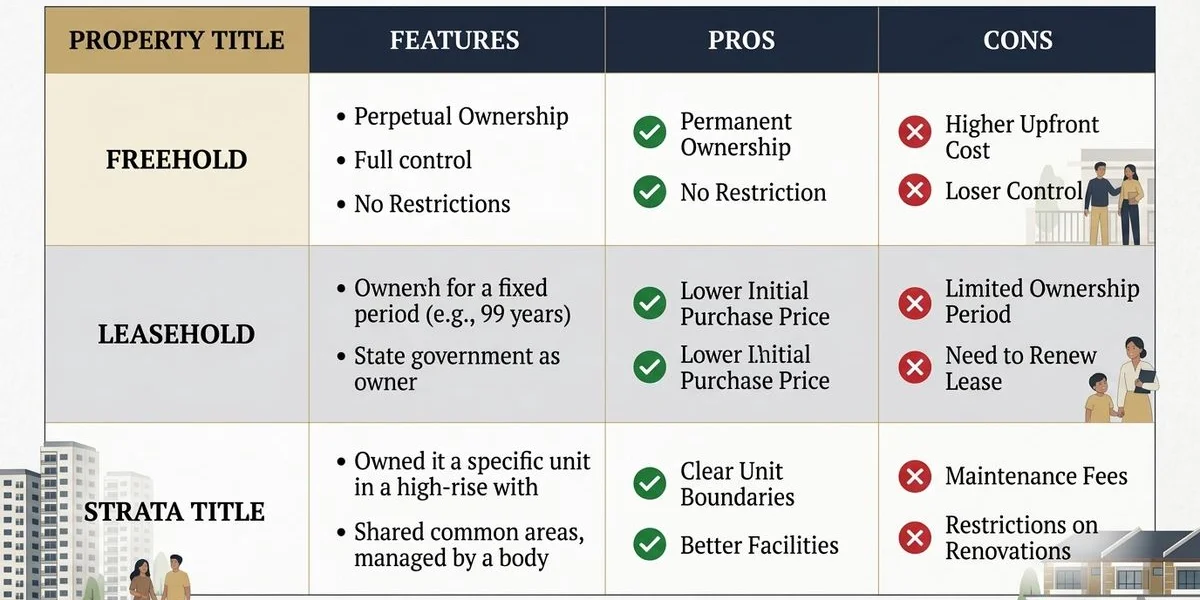
This comparison distils the fundamental differences in terms of personal capital appreciation potential and the uncertainties of future lease renewal obligations. Use this summary to identify which instrument best matches your retirement or investment strategy.
Freehold
This perpetual ownership status delivers absolute peace of mind — with no threat of land lease expiry from the state government. Its near-immunity to depreciation makes it a must-own wealth portfolio asset when your financial reserves support it.
Pros:
- Healthy capital appreciation averaging 6%–7% per year on a sustained basis
- No obligation to pay any renewal premium or JPPH assessment charges in future
- Qualifies for the most flexible bank financing margins without remaining-lease restrictions
- Safe to use as a stable intergenerational wealth transfer instrument
Cons:
- Higher upfront deposit required, as sale prices are typically at a 10%–20% premium
- Availability of modern landed freehold developments is relatively limited and grows slowly
Leasehold
Leasehold offers a strategic entry path for young professionals seeking a premium address in a key location. The most critical considerations are the ability to maintain a safe remaining tenure and planning for an early sale.
Pros:
- More accessible entry pricing — typically 15%–25% cheaper than freehold equivalents
- Potential to generate attractive rental yields due to lower entry cost
- Access to lifestyle mega-developments with sea views such as Bayan Bay
Cons:
- Sale price exposed to significant value erosion once the remaining tenure approaches the 60-year warning mark
- Future land premium renewal charges are variable and cannot be precisely estimated today
- Resale approval can face delays due to state government written consent requirements for title transfer
Final Recommendations
In the freehold vs leasehold Penang comparison, your investment analysis should focus on remaining lease years versus price — not price alone. A strategy anchored in this clarity guards against sudden value depreciation when economic conditions shift.
Documented cases confirm that budget purchases made without thoroughly examining the developer’s track record and remaining title period frequently result in problems down the line.
For investors and buyers with a holding horizon beyond ten years, apply these three principles:
- Prioritise Freehold: If your budget is solid and a freehold option is available in your target area, make it your first choice — even if you have to pay a market premium of 10%–20%.
- Evaluate the Leasehold Development’s Track Record: If your target zone is exclusively leasehold (such as a new reclamation area like STP), examine the building management record thoroughly and confirm the remaining tenure is above 85 years minimum.
- Avoid the Red Zone: Firmly rule out any purchase where the remaining lease is below 60 years unless the offered price is extraordinarily low — at least 30% below comparable market value.
For a comprehensive understanding of the full classification of property title types in Malaysia, read the guide to property title types: freehold, leasehold, and strata title. To view new property projects in Penang and Kedah, browse our listings.