Long-Term Tenancy Agreement in Malaysia: Complete Guide
Standard lease structure, deposit clauses, renewal mechanics, stamp duty on tenancy agreements, and termination conditions — for landlords and tenants.
Alpian Ali
Perunding Hartanah Berdaftar · Updated 24/04/2026
A Tenancy Agreement Is Not Just a Formality
This legal contract is the primary protection instrument for both landlord and tenant. A well-drafted document makes the entire rental process — whether for a condominium in Gurney Drive or a terrace house in Bayan Lepas — significantly easier to manage.
Making informed decisions based on accurate Penang luxury rental market information protects your investment from the outset. Complete and properly structured documentation prevents the most common causes of financial loss in rental disputes.
A standard long-term tenancy agreement in Malaysia covers a period of 1–3 years. This guide explains the essential elements every contract must contain.
Mandatory Elements of a Tenancy Agreement
Every agreement must include specific details to prevent ambiguity. The right structure allows disputes to be resolved quickly and with clear legal footing.
1. Identification of All Parties
This section must display the official identity of everyone bound by the contract:
- Full legal name as per national ID card or passport
- IC number for Malaysian citizens, or passport number for expatriates
- Registered correspondence address for delivery of formal notices
- Full property details including the land title reference number
Tenants are advised to conduct a title search at the Land Office or official portal before paying any deposit. This confirms the actual legal owner of the property.
2. Lease Duration
This section defines the lifespan of your tenancy agreement:
- Exact commencement date
- Exact expiry date
- Annual renewal option if mutually agreed
Renewal notices typically require 2–3 months’ advance notice — giving the landlord sufficient time to find a new tenant if the lease is not extended.
3. Rental Rate
All financial details must be recorded precisely to prevent disputes:
- Monthly rent amount
- Payment deadline — typically within the first 7 days of each month
- Payment method — online bank transfer is recommended for a clear paper trail
Late payment allows the landlord to impose a penalty. Malaysian courts permit a late payment interest charge of 8% per annum on the outstanding amount.
4. Deposit Structure
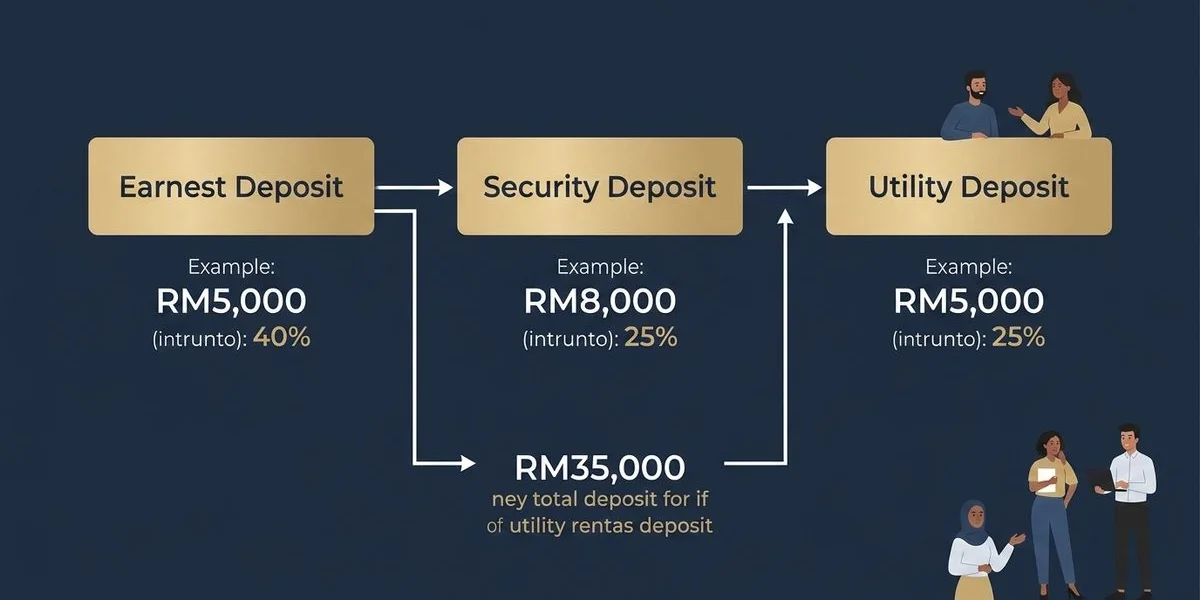
The Malaysian standard uses a 2+1+0.5 deposit formula for maximum protection:
- Earnest deposit: 1 month’s rent paid with the Letter of Offer
- Security deposit: 2 months’ rent paid at contract signing
- Utility deposit: 0.5 month’s rent for electricity, water, and internet bills
Total deposits amount to 3.5 months of the monthly rental rate — plus the first month’s rent paid in advance.
The earnest deposit must be held securely in the client account of a registered agency under the Board of Valuers, Appraisers, Estate Agents and Property Managers (BOVAEP/LPPEH). These funds must not be transferred to the landlord until the formal agreement is fully signed by all parties.
5. Usage Clauses
Residential property is subject to local authority by-laws. Commercial activity cannot be conducted in a standard residential premises:
- Premises to be used for residential purposes only
- Maximum number of occupants relative to the unit size
- Clear terms on whether pets are permitted or prohibited
- Strict no-smoking rules within the premises (if applicable)
6. Landlord’s Responsibilities
Property owners are obligated to ensure the premises remain safe and habitable:
- Major structural repairs — roof leaks, main plumbing failures
- Purchase of fire insurance covering the building structure
- Monthly payment of strata management fees
- Annual settlement of assessment tax and quit rent
Indah Water Konsortium (IWK) sewerage bills are also generally the landlord’s responsibility unless the contract states otherwise.
7. Tenant’s Responsibilities
Tenants must maintain the property as if it were their own:
- Pay rent in full and on time every month
- Settle all utility bills — TNB electricity, water, and internet
- Maintain cleanliness and carry out basic daily upkeep
- Bear the cost of any damage caused by their own negligence
Many modern contracts define a minor repairs clause. Tenants typically bear the cost of small-scale damage below RM150–RM200 per incident.
8. Termination Clauses
Contract termination must follow proper legal procedure and cannot be done arbitrarily:
- Standard termination requires 2–3 months’ formal written notice
- Early termination by the tenant typically results in full security deposit forfeiture
- Serious contractual breaches — such as illegal activity on the premises — allow immediate termination
Landlords must be reminded of Section 7(2) of the Specific Relief Act 1950, which strictly prohibits forcible lockout of premises. A court order is required before evicting a tenant who refuses to vacate.
Stamp Duty on Tenancy Agreements
Your signed agreement must be stamped at the Inland Revenue Board (LHDN) to be legally admissible as evidence in court.
The tenant typically bears this stamp duty cost. LHDN now processes all tenancy stamp duty through the STAMPS online portal for faster calculation, payment, and digital certificate issuance.
Standard Calculation Examples:
| Monthly Rent | Annual Rent | Stamp Duty |
|---|---|---|
| RM3,000 | RM36,000 | RM144 |
| RM5,000 | RM60,000 | RM240 |
| RM10,000 | RM120,000 | RM480 |
| RM15,000 | RM180,000 | RM720 |
Additional Clauses for Luxury Leases
Residences or condominiums valued above RM5,000 per month require stronger legal protections than a standard lease provides.
Furniture Schedule Clause
A furniture inventory records the complete list and condition of every item in the property. High-value furnishings require meticulous condition records.
Photograph every room and item with visible date-stamps in each image. The final inspection at the end of the tenancy will refer back to these original photo records when assessing any damage claims.
Diplomatic Break Clause
Designed specifically to protect tenants who are trade officials or expat employees. Employers frequently relocate staff to other countries with limited advance notice.
Under this clause, tenants may terminate the lease early by providing at least 2 months’ written notice, accompanied by an official relocation confirmation letter from their employer or the Expatriate Services Division (ESD).
Rent Review Clause
Long-term contracts require rental rate adjustments to keep pace with current market conditions. Inflation has a direct ongoing effect on property values.
Landlords may include a clearly defined annual increase mechanism in the lease. Rent increases are typically capped at 3%–5% or calculated against the Consumer Price Index (CPI).
Force Majeure Clause
Natural disasters or uncontrollable pandemic crises can impair a tenant’s ability to meet monthly payment obligations — a concern that became very real after COVID-19.
This clause allows temporary suspension of rental payments to avoid excessive financial burden. The agreement may also allow termination without penalty if a declared emergency persists beyond a defined period.
Pre-Signing Process
A systematic workflow ensures a smooth and dispute-free key handover. The process involves several technically important stages:
- Draft Preparation: The landlord engages a solicitor or registered estate agent to prepare the initial draft document
- Document Review: The tenant reads and fully understands all terms — ideally with a legal advisor present
- Negotiation: Both parties discuss and agree on any clause amendments
- Letter of Offer: The tenant signs and pays the earnest deposit upfront
- Contract Signing: Full payment of security deposit, utility deposit, and first month’s rent is made at main contract signing
- LHDN Stamping: Stamp duty is settled via the STAMPS portal within 14 working days
- Key Handover: The landlord transfers full physical access including access cards on the contract start date
Tips for Landlords
Selecting the right tenant saves significant time and financial loss in the long run:
- Screen candidates using a CTOS credit report to verify their debt repayment track record
- Request the last 3 months’ payslips as evidence of financial stability
- Record a full video walkthrough of the property’s physical condition before handing over keys to a new tenant
- Use a BOVAEP/LPPEH-registered agent to eliminate any risk of deposit handling fraud
You have the right to decline an application if a prospective tenant requests too many unreasonable clause amendments. A better-qualified tenant will come.
Tips for Tenants
Careful steps before signing will ensure your rights and deposit money are fully protected:
- Read all terms thoroughly — particularly the late payment penalty rate stated in writing
- Request and retain the original furniture inventory photos via email for future reference
- Keep all copies of bank transfer receipts to the agent or landlord account safely
- Ensure the document carries the official LHDN stamp — without it, you cannot rely on the agreement as evidence in court
Check the status of any existing utility arrears with the relevant authorities before moving in. This prevents you from being held responsible for unpaid bills left by the previous tenant.
Luxury Rentals in Penang
Premium properties in Penang consistently attract high demand from expats, MM2H holders, and diplomatic families. The latest market data confirms luxury units maintain strong occupancy rates across key locations.
For current rental rate benchmarks in the Gurney Drive, Tanjung Bungah, and Seri Tanjung Pinang corridors, read the Gurney Drive & Tanjung Bungah luxury rental market guide. For the full breakdown of upfront rental costs including deposit structure and stamp duty, refer to the luxury rental cost guide for Malaysia.